Restricted items
Items Requiring Special Precautions
Japanese / English
The law prohibits bringing dangerous goods on a flight or checking them in baggage. Thank you for your understanding.
Information
To make a reservation on the Internet, it is now mandatory that customers read the Cautions concerning baggage.
Thank you for your cooperation.
Items with Carry-On and Check-In Restrictions
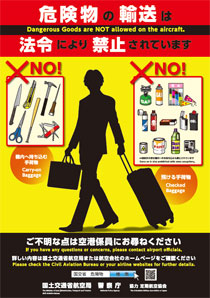
Explosive, flammable, or harmful or potentially hazardous items or those which could damage other items cannot be transported by aircraft by law and may not be checked in or carried on. Knives and any item that can be used as a weapon cannot be carried on board the aircraft.
A list of example items that are prohibited or permitted under certain conditions to be carried on or checked in is available on the Ministry of Land, Infrastructure, Transport and Tourism website. Passengers should ensure in advance that their belongings do not contain any items that can be identified as dangerous goods.
- Click here for the list of example dangerous goods. (The Ministry of Land, Infrastructure, Transport and Tourism website)
- Check your belongings for dangerous goods before you go to the airport. Click here for items you cannot carry on.
(Government Internet TV: created by The Ministry of Land, Infrastructure, Transport and Tourism) - Wheelchair Check-In
Plant Transport Regulations
There are restrictions on bringing Satsuma sweet potatoes (excluding those that undergo government disinfection), Japanese morning glory and uninspected citrus seedlings or scions from Okinawa to mainland Japan. They may not be checked in or carried onto a flight.

Mobile electronic devices containing lithium batteries
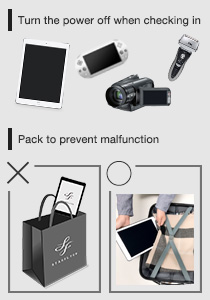
To prevent conditions in which a mobile electronic device using lithium batteries could ignite in a location you cannot see, the Japan Civil Aviation Bureau ordered mandatory safety procedures for the transport of such devices in a Cargo Compartment.
To check-in electronic devices containing lithium batteries
- 1
Turn the device completely OFF.(do not put it in Sleep Mode)
- 2
To prevent ignition from sudden movement or damage, protect the device in a sturdy suitcase or by wrapping it in clothing.
- *
Mobile batteries and spare batteries using lithium batteries (batteries removed from electronic devices such as digital cameras) cannot be checked in as checked baggage in the cargo hold.
Airport Handling of Dangerous Goods
A list of example items that are prohibited or permitted under certain conditions to be carried into the cabin or checked in is available on the Ministry of Land, Infrastructure, Transport and Tourism website.
Passengers should ensure in advance that their belongings do not contain any items that can be identified as dangerous goods. If it cannot be determined whether an item can be transported by the departure time, your request to transport it may be refused. Thank you for your understanding.
Handling of mobile batteries on board
Based on a request from the Ministry of Land, Infrastructure, Transport and Tourism Aviation Bureau, we ask for your cooperation regarding the handling of mobile batteries on board the aircraft. If you notice anything abnormal, please promptly inform a cabin crew member.
- 1
Do not store mobile batteries in the overhead compartment.
To ensure a swift response in the event of a malfunction, always keep mobile batteries with you or in a place where you can always monitor them, such as the seat pocket in front of you. - 2
Do not use mobile batteries.
If you need to charge electronic devices, please use the onboard USB ports or power outlets. Portable electronic smoking devices, such as heated tobacco products or e-cigarettes, may not be charged on the aircraft under any circumstances or in any location. - 3
Do not charge mobile batteries using onboard power.
- *
Charging mobile batteries from onboard power is prohibited.
- *
- 4
To prevent short circuits, cover the terminals with tape or place the battery in a plastic bag or similar for insulation.
- LightersOpen
Item (type) Carry-on Checked baggage Remarks Gas lighters (Disposable/refillable) ○ × Limited to smoking items for personal use. - * For smoking, 1 item per person may be carried into the cabin on one’s person.
Oil lighters With absorbent cotton ○ × Without absorbent cotton
(Oil tank lighters)× × - Cigar lighters
Pre-mixing lightersTurbo lighters, jet lighters, blue frame lighters, etc. × × A pre-mixing lighter is the type of lighter that puts out a “blue flame” and “strong flame” in the same manner as a cigar lighter. Lighter types and differences
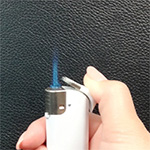
Pre-mixing
lighter-type flame
(Carry-on × / Checked baggage ×)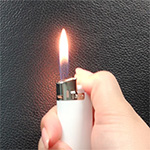
Regular lighter flame
(Carry-on ○ / Checked baggage ×)
- Hair curlers (curling irons) Open
Item (type) Carry-on Checked baggage Remarks Electrical outlet type ○ ○ - Battery type
(Removable battery models)○ × If the battery is lithium ion, the battery can be removed and carried on board. Battery type
(Non-removable battery models)× × - Gas-type ○ ○ Models filled with hydrocarbon gas, fitted with a safety cover on the heat source. - * Up to 1 per person
- * Spare hydrocarbon gas cartridges to fill the curling iron may not be carried on or checked.
- Instant cold packs Open
Item (type) Carry-on Checked baggage Remarks Instant cold pack × × <Item Features>
When the pack is hit, the chemicals inside react with water and begin cooling.(Example) Instant cold pack

- Regarding general electronic devices with a built-in/attached lithium batteryOpen
Regarding general electronic devices with a built-in/attached lithium battery
Product examples
Cell phones, cell phone chargers, radios, walkie-talkies, laptop computers, digital cameras, portable terminals, portable printers, printers, portable data terminals, e-readers, mobile game devices, camera equipment, etc.
- *
Electrically powered vehicles (such as hoverboards, electric skateboards, self-balance boards (Segways) and e-bikes) cannot be carried on or checked for safety reasons.
Electric devices
The lithium content of the lithium metal battery shall not exceed 2g, or the watt-hour rating of the lithium-ion battery shall not exceed 160Wh in carry-on/check-in baggage.
- *
Turn the device completely OFF. (do not put it in Sleep Mode)
- *
Protect the device in a sturdy suitcase or by wrapping it in clothing. (To prevent ignition caused by sudden movement or damage)
Mobile Batteries
Regardless of the Wh rating, each person can carry up to a total of 2 mobile batteries on board. They cannot be checked in.
- *
Mobile batteries with a rated watt-hour exceeding 160Wh cannot be carried on board or checked in.
- *
Items whose capacity cannot be confirmed also cannot be carried on board or checked in.
Spare batteries (batteries removed from electronic devices such as digital cameras)
Lithium metal batteries … those containing 2g or less of lithium
Lithium-ion batteries … those with a rated watt-hour capacity over 100Wh but not exceeding 160Wh
The above can be carried on board up to a total of 2 per person.
They cannot be checked in. Also, items whose capacity cannot be confirmed cannot be carried on board or checked in.Request Regarding Batteries in General
For safety, please take measures to prevent short circuits for spare batteries, including lithium batteries and other batteries (such as nickel-metal hydride batteries and dry batteries), by protecting the terminals with tape or placing them in a plastic bag, etc.
- *
- Spare batteries for motorized wheelchairs Open
Lithium-ion batteries (including lithium-ion polymer batteries)
Each passenger can carry-on up to 2 batteries of 160 watt-hour (Wh) or less rating. They cannot be checked.
Each passenger can carry-on up to 1 battery in excess of 160 watt-hour (Wh) but equal to or less than 300 Wh. They cannot be checked.
Batteries in excess of 300 watt-hour (Wh) cannot be carried on or checked.- *
Batteries attached to a wheelchair are not counted as spare batteries.
- *
If you remove a battery, please carry it into the cabin in wrapping to protect it from impact.
NiMH, NiCad and other dry batteries
Each person can check up to 1 battery. They cannot be carried on.
- *
While the standards of the Ministry of Land, Infrastructure, Transportation and Tourism do not restrict the number, Star Flyer establishes restrictions based on the International Air Transport Association (IATA) Dangerous Goods Regulations.
Leak-proof wet batteries
Each person can check up to 1 battery. They cannot be carried on.
Non-leak-proof wet batteries
Spares cannot be either checked or carried on.
- *
- Smart BaggagesOpen
Smart baggage with non-removable lithium batteries
NOT ALLOWED as either carry-on or checked baggage.
(If the lithium battery cannot be removed, the baggage cannot be brought on board or checked in.)Smart baggage with removable lithium batteries
ALLOWED as both carry-on and checked baggage.
(The battery must be removed if checked in.)
*Size restrictions apply.Exceptions for small lithium batteries
Smart baggage with the following battery specifications is ALLOWED as both carry-on and checked baggage, even if the battery cannot be removed:
- Lithium metal batteries: Lithium content of 0.3 g or less
- Lithium-ion batteries: Watt-hour rating of 2.7 Wh or less
*Size restrictions apply. - Other Open
Item (type) Carry-on Checked baggage Remarks e-cigarettes ○ × Limited to items for personal use. Spare batteries must have short-circuit prevention measures in place. Do not charge in the cabin. Gas cartridge cabin stove ○ ○ Stoves with no remaining gas.
(Gas cartridges can not be carried on or checked.)Paints/coatings × × - Fireworks × × - Dry ice ○ ○ Items used to chill fresh foods. Up to 2.5 kg per person
If a passenger has dangerous goods that cannot be carried on or checked, they will be asked to dispose of them in the Abandoned Goods Bin at a security checkpoint.
Please check in any acceptable items as checked baggage at the check-in counter.